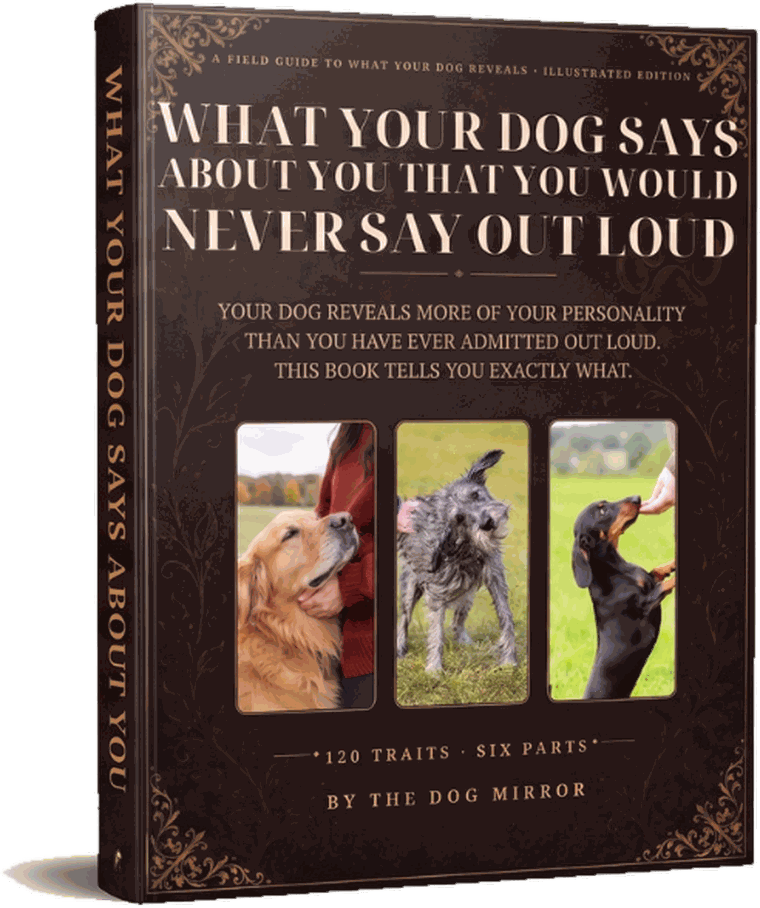
You did not pick your dog the way you pick a kettle. Somewhere between the breed you searched for, the size you told yourself you could handle, and the one face in the shelter row that stopped you, a set of decisions got made — and almost none of them were made consciously. This book contains 120 of those decisions, and what each one gives away about the person who made it.
“Trait 46 — ‘Repeating the Command’ — ended an argument my wife and I have been having for six years. I read the blind spot line twice, then went and told her she had been right about it.”

Marcus D.47, Bozeman, Montana
“I bought it for the breed chapter and got ambushed by Part Four. ‘The Way You Leave’ described my exact morning routine and then explained what it was doing to my dog. I have changed it.”

Cheyenne R.34, Asheville, North Carolina
“Part Six is why I recommend it. ‘Whether You Would Get Another’ is the kindest page I have read about losing a dog, and I have read a lot of them this year.”

Deanna W.56, Tulsa, Oklahoma
Where the dog sleeps. What you say to it when nobody is listening. How many times you repeat a command before you give up. What you do when it embarrasses you in front of a stranger, and what you do the moment the stranger walks away.
None of those felt like statements about you at the time. They were just Tuesday. But they were made by a person with preferences, a tolerance for mess, a way of handling disappointment and a private idea of what being needed is worth — and they add up into a record that is far harder to edit than anything you would say about yourself out loud.
This book reads that record back to you. Each of the 120 entries takes one choice, habit or reaction, describes it plainly, and then tells you the same four things: the pattern it usually reflects, the real strength that comes with it, the cost running quietly in the background, and one specific small thing worth trying.
Some of it is flattering. A fair amount of it is not. All of it is stated without softening, because a mirror that flatters is not a mirror — and because the entries you keep recognising are the ones that carry the signal.
There is no shortage of dog content. Very little of it is actually about you.
| This book | Breed quizzes & personality tests | General dog-psychology books | |
|---|---|---|---|
| Who it is about | The owner. The dog is the evidence. | Neither, really — a score at the end | The dog, almost entirely |
| How specific | 120 named choices, from crate to nickname to the night it was sick | Ten questions, four archetypes | Broad principles, few concrete habits |
| What each entry gives you | Pattern, strength, blind spot, one thing to try | A label | Background reading |
| Honesty about limits | Says which patterns are well established and which are tendencies | Presents guesses as results | Varies wildly |
| How you read it | Straight through, or opened anywhere — every entry stands alone | Once, then never again | Front to back or not at all |
| What you do next | Mark the entries that land; the marked pages make a shape | Screenshot the result | Nothing in particular |
120 traits, six parts, 72 illustrated pages. These are the real contents.
The one decision you made before the dog could influence you — you alone, working from a picture of the animal you wanted beside you and, underneath it, the person that animal would make you look like.
How much of your home, your body and your control you were willing to hand over — and what you kept back.
Authority, patience and consistency, measured in the one arena where you cannot argue your way out of the result.
The things you repeat without deciding to. Feeding, walking, leaving, coming home — the habits that show what you actually value, not what you say you do.
Language is the cheapest thing to give and the hardest to fake. The name, the voice, the things you say to it that you would not say to anyone with a vote.
The part most books avoid: attachment, anxiety, money, the growl, the diagnosis, and the question you have already asked yourself at three in the morning.
So you can read it straight through or open it anywhere and still know exactly what you are looking at.
The Dog Mirror started from a small, slightly uncomfortable observation: people will tell you almost nothing honest about themselves in a conversation, and almost everything in the way they handle their dog.
The work behind this book comes from three places. Personality research on the traits that actually predict which animal a person picks. Attachment theory, and the body of work extending it to the bond between people and the animals they live with. And the behavioural evidence — the sturdiest part of it — showing how reliably an owner’s stress, consistency and tolerance travel down the lead and come back out as the dog’s behaviour.
What that research does not do is tell you what your particular crate rule, nickname or walking route means. That is the gap this book fills: 120 concrete, recognisable choices, each read back to you in plain language, with the strength named alongside the blind spot.
It is written to be read the right way. These entries describe tendencies across many people, not verdicts about anyone. Any single entry can miss you completely and the book still works. It is the entries you keep recognising that carry the signal.
It is a popular book, not a journal paper, and it does not pretend otherwise. The patterns come from established fields — trait research on pet choice, attachment theory, and the behavioural work on owner-to-dog transmission of stress and consistency — and the book is explicit about the strength of each one. Where something is well established, it says so. Where it is a tendency rather than a rule, it says that too.
What it is not: a diagnosis, a test, or a score. There is no result at the end. There are 120 descriptions, and the ones you keep recognising are the finding.
A post gives you one trait and a comment section. This gives you all 120 in order, arranged into six parts that build on each other, with the strength, the blind spot and the thing to try attached to every single one — the parts that do not fit in a caption.
It is also yours offline, on any device, and it does not disappear when an algorithm changes its mind.
Because it is a digital file. There is no printing, no shipping and no warehouse, so the price reflects what the writing is worth rather than what a paperback costs to move around the world. This is the first-edition launch price; it is the lowest it is intended to be.
A 72-page illustrated PDF, delivered by Gumroad the moment the payment clears — usually within a few seconds, as a download link on screen and a copy by email. It reads on a phone, tablet, e-reader or laptop, and prints cleanly if you would rather mark it up on paper.
Yes, and Part One ends with an entry written for exactly that (“The Dog You Did Not Choose”). Breed choice is only the first twenty traits. The other hundred are about what you have done since: the room you give it, the voice you correct in, what you repeat, what you let slide, what you call it, and what you do at three in the morning when something is wrong.
Almost certainly, in a few places. Every entry names a blind spot, including the entries about the choices you are proudest of — and every entry names a genuine strength, including the ones that sting. That balance is the design. Nothing here is a judgement of you as an owner, and nothing here replaces a conversation with a professional, whether that professional treats dogs or people.
Yes — Gumroad has a gift option at checkout, and you can send it to any email address. It lands as a download link, which is a slightly odd thing to wrap but an easy thing to send.
That You Would Never Say Out Loud — First Edition
You already know which of the 120 you would recognise first.
120 traits. Six parts. 72 illustrated pages, and one small thing worth trying at the end of every entry.